Drywall Materials Explained: A Guide for Pikesville Homeowners and Condo Owners
Behind a repaired wall is a small kit of materials, and each has a particular job. This guide introduces them one at a time and says when a repair uses each, so you can follow what we are doing.
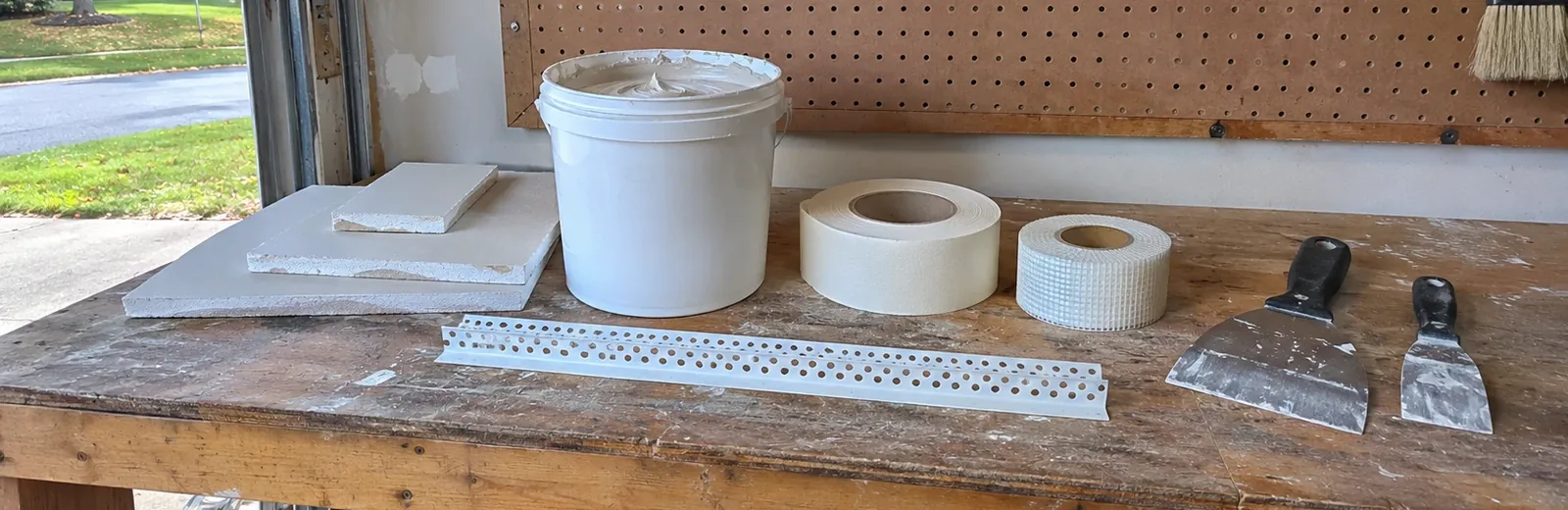
Board: the flat sheet itself
Drywall board is a layer of gypsum, a soft mineral, pressed between two sheets of heavy paper. Notice that the paper does real work: it gives the board its strength and its surface, so a torn paper face is a bigger problem than a small dent.
Ordinary board is the usual choice for walls and ceilings in living spaces. Thicker board, often marked as fire-rated, has a core made to slow the spread of fire, and it is common between units in multi-unit buildings. If you live in a Pikesville condo or apartment, a wall or ceiling may be part of such an assembly, and we confirm that with your building before cutting, because the new piece must match what is there.
Moisture-resistant board has a treated face and is used where a wall meets damp conditions, such as around a tub. It resists humidity but it is not waterproof, so a leak above it still needs repair.
Joint compound: the mud
Joint compound, often called mud, is the paste that fills seams, holes and screw heads. It comes in a few kinds, and the choice depends on the job. First, a premixed all-purpose compound is the everyday choice for filling and finishing. Then there is a lighter version that sands easily, good for the final thin coats. Finally, setting-type compound arrives as a powder you mix with water, and it hardens by chemical reaction instead of by drying.
Why choose the setting kind? Because it hardens at a predictable time even in damp air, so it is useful for deep fills and for the first coat on a large patch. Baltimore County summers are humid, and slow-drying compound can delay a job, so a setting-type base coat helps keep the schedule honest.
Tape: the stitches
Tape is what lets two pieces of board act as one. Paper tape is pressed into a thin layer of compound and gives a strong, flat seam. Mesh tape sticks on its own and is handy for patches, but it needs setting-type compound to hold well.
A crack in an older wall is bridged with tape for the same reason you would stitch a tear in cloth: the tape spreads the strain over a wider area so the line does not reopen with every change of season.
Fasteners and corner bead
Drywall screws hold board to framing, and a repair uses them instead of nails because they grip better and are less likely to pop out as a house moves. The screw head is set just below the surface, then covered with compound.
Corner bead is a thin strip of metal or plastic that protects an outside corner. A damaged corner is usually repaired by replacing the bead, then covering it with compound.
Primer and plaster
Primer is a thin coat that seals the repaired surface so paint takes evenly. Without it, a patch can look dull under the paint. After a water stain, a stain-blocking primer is the one that keeps the ring from rising back.
Plaster is a different material, common in some houses from the 1940s through the 1960s. It is harder and thicker than drywall, and repairs to it often use setting-type compound or a plaster patching product. We tap the wall and look at the edges to learn which one you have, and then we choose to match.
Putting it together
A typical patch uses several of these in order. We fasten a piece of board, tape the seams, coat with setting compound, finish with lighter compound, sand, and prime. Each step is chosen because of the one before it.
If you would like to see how this plays out in a specific case, read the repair pages for ceiling leaks, holes and dents, and smooth-wall patching.