Drywall Hole and Dent Repair in Pikesville
A hole in a wall looks alarming, but it is one of the most predictable repairs there is. The size of the hole decides the method, and we will walk through each size here.
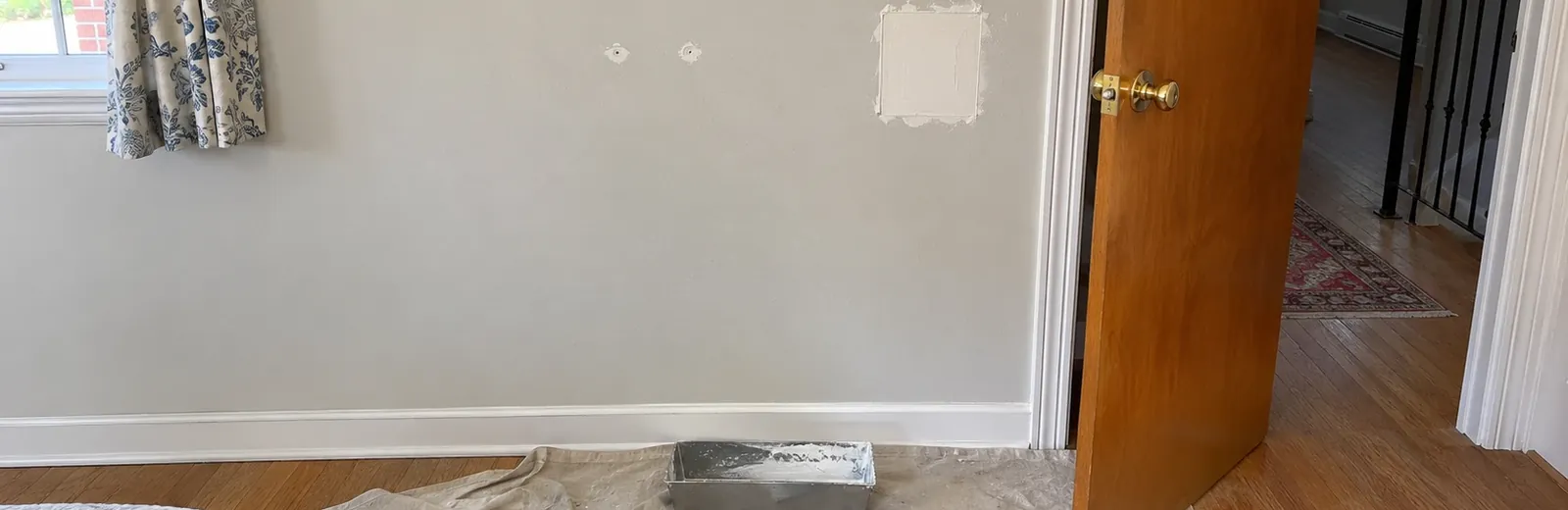
Start with the size
Think of it like repairing a hole in a shirt. A pinprick needs almost nothing, a button-sized hole needs a small patch, and a big tear needs a new panel. Drywall works the same way, and we sort holes into three sizes.
Small holes, such as nail holes and screw pops, are filled with compound in two or three thin coats. Medium holes, about the size of a doorknob dent up to a hand, get a self-adhesive mesh patch with compound over it. Large holes, such as a removed access panel, need a new piece of board fastened to backing that we add inside the wall.
The usual causes
- A door opened too hard, so the knob pushed a round dent into the wall behind it.
- A television mount taken down, leaving a set of anchor holes in a neat rectangle.
- A chair, a bed frame or a moving box that met the wall at the wrong angle.
- A cut-out opened for a plumber or electrician and never closed properly.
- A heavy picture removed along with a chunk of paper face.
Why a patch can show through paint
Here is the part that surprises people. A patch can be perfectly flat and still be visible once painted. The reason is that compound and paper absorb paint at different rates, so the repaired spot looks duller, like a patch of dry bread beside a glazed roll.
To prevent that, we prime the repair before the paint goes on. The primer seals the surface so the topcoat dries evenly. We also feather the compound, meaning we spread the last thin coat well beyond the hole, so there is no ridge to catch the light.
The order of a hole repair
- We cut away loose paper and crumbled board until the edge is solid.
- For a medium or large hole, we add backing or place a patch, and fasten it.
- We apply the first coat of compound and let it dry.
- We apply a thinner second coat that reaches farther out, then let it dry again.
- We sand lightly, wipe the dust, and prime.
When a hole is not only a hole
Sometimes a hole is a clue. A cluster of small holes in a straight line usually means a shelf or a mount was removed, and that is routine. A round dent behind a door is simply a doorknob that met the wall. But a hole with soft, crumbling edges, or one with a stain around it, may mean moisture has reached the board, and then the better question is where the water came from.
In condos and apartments, a hole also raises a practical matter: some units have walls that are part of a fire-rated assembly, so a large access cut should be closed with the same kind of board that was there. We check before we cut, and we match what we find.
Before we arrive
- Take down any shelf or picture hanging near the hole.
- Keep a spare of the paint, or note its name, so you can touch up afterward.
- Tell us if something such as a pipe or wire may run behind the hole.
A few quick questions
Can you patch a doorknob hole without replacing the wall?
Yes. A hole that size is a small, ordinary patch, and we also suggest a door stop so it does not happen again.
How long must I wait before painting?
Compound needs time to dry between coats. We tell you when the repair is ready, because a patch that is painted too early can shrink or flash.
Do you repair dents with no hole?
Yes. A shallow dent is filled with compound, and a deeper one with a patch, then sanded flush.
Will you paint afterward?
We leave the wall primed and ready. Say so when you contact us if you want help with painting.