Smooth-Wall Drywall Patching and Skim Coating in Pikesville
Smooth walls are the least forgiving, because there is no texture to hide behind. A good patch here is about patience and thin layers, and we can explain exactly why.
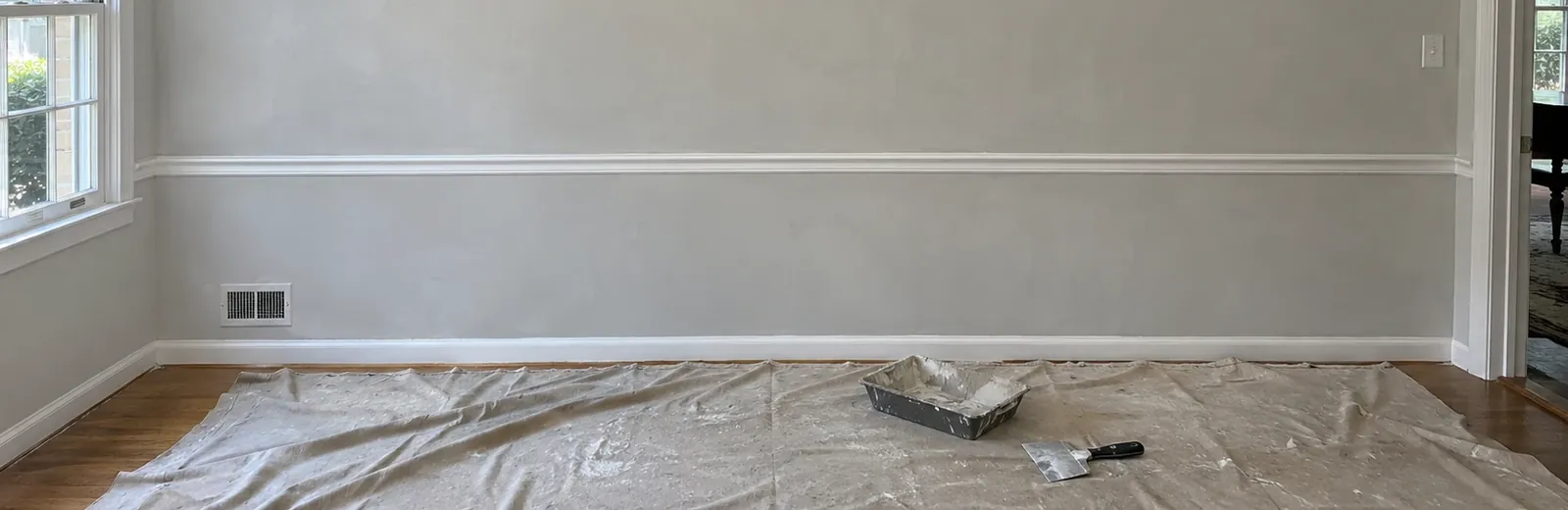
Why smooth walls show every mistake
Picture a sheet of glass and a piece of sandpaper. A scratch on the sandpaper disappears; the same scratch on the glass is seen from across the room. A smooth painted wall behaves like the glass, and light that skims across it reveals even a slight ridge.
So the goal is not a patch that is hidden but a patch that is level with the wall in every direction. We check by running a hand across it and by shining a work light along the surface at a low angle, which is the angle that exposes flaws.
Signs a wall may need a skim coat
- Several old patches that stand out as dull or raised spots.
- A surface with ridges, trowel marks or a bumpy orange-peel texture you want to remove.
- Wallpaper residue or torn paper after wallpaper has been taken down.
- A wall that looks wavy in raking light from a window.
- Many small repairs close together, such as those from a removed picture gallery.
What skim coating is
Skim coating means spreading a very thin layer of compound over a whole wall, the way you would spread frosting over a cake with a wide knife. The thin layer fills small dips and scratches and gives the entire wall one even surface.
We do it in stages. First we scrape off loose paint and bumps and wash the wall. Then we prime if the surface needs it, so the compound grips. Next come one or two thin coats, each left to dry. Finally we sand lightly and prime again, so the paint takes evenly.
Patching without skim coating
- We fill the hole or crack so it sits slightly below the surface.
- We add a thin coat that reaches several inches past the edge.
- We add another that reaches farther still, so the repair fades into the wall.
- We sand flat with a light touch, and check with raking light.
- We prime the whole patch so it takes paint like the rest of the wall.
A word about paint sheen
Glossier paints show flaws more; flat paints hide them. If your walls are painted in a satin or semi-gloss, a patch needs more careful work, and repainting the full wall gives the most even look. We will tell you what we see and leave the choice with you.
In Baltimore County, humid summers can slow the drying of compound, so we allow extra time between coats rather than rush a layer that is not yet dry.
Before we arrive
- Remove pictures, shelves and outlet covers if you are able, or tell us and we will.
- Tell us which paint finish is on the wall.
- Choose the wall color early, because paint timing affects when the wall is truly finished.
A few quick questions
How many coats does a smooth patch need?
Usually two or three thin coats. Thin layers dry faster, sand easier and disappear better than one thick one.
Is skim coating the same as repainting?
No. Skim coating changes the surface of the wall, and paint is applied afterward to give it color.
Can you match a textured wall too?
Yes, in many cases, though smooth finishes are our focus. We can test a small area first.
Will I see the patch in bright light?
A careful patch should not show, even under raking light. We check it that way before we finish.